
DEVELOPMENT OF PHARMACEUTICAL PRODUCTS 1(NFNF2213) LAB REPORT
Lecturer’s Name : Associate Professor Dr. Haliza Katas
Group members:
- Aisyah Nuha binti Mohd Sor (A172179)
- Nur llyana binti Jamali (A168237)
- Arifah Bt Abdul Razak (A168784)
- Nur Anis Sofiah binti M Rahim (A171660)
- Mohammad Jundullah bin Morni (A167616)
SEMESTER 1, SESSION 2019/2020
Introduction
Suspension is a heterogeneous mixture that has two phases. It consists of insoluble solid particles that mixed together with a liquid medium. Insoluble particles are called by dispersed or internal phase while liquid medium is a continuous or external phase. Suspension is an important class for pharmaceutical dosage form, especially for drugs that are insoluble in other dosage form.
The advantages of suspension are it have effective dispensing of hydrophobic drugs, it can mask the unpleasant taste of certain ingredients and it also offers resistance of degradation of drugs due to hydrolysis, oxidation or microbial activity. It chemically more stable than in a solution. However, suspension tend to settle over time leading to lack of uniformity of dose. It is also difficult to achieve uniform and accurate dose unless it packs in dosage form.
In this experiment, we try not to eliminate to separation but rather to decrease the rate of settling. Therefore, the suspended particles should not settle rapidly and resulting the sediment. The suspension must be easily re-suspended by shaking the suspension before use. By using wetting agents like tragacanth it can help to reduce the surface tension in the sedimentation.
Objective
To investigate the effect of different amounts of Tragacanth on the sedimentation rates of suspensions as wetting agents.
Materials
Chalk
Tragacanth
Concentrated Peppermint Water
Double Strength Chloroform Water
Distilled Water
Syrup BP
Apparatus
1 x 1 mL graduated pipette
1 x Pipette bulb
1 x Weighing boat
1 x Set of Mortar and Pestle
4 x 200 mL graduated cylinder
4 x 100 mL beaker
1 x Weighing balance
1 x Viscometer
Procedure
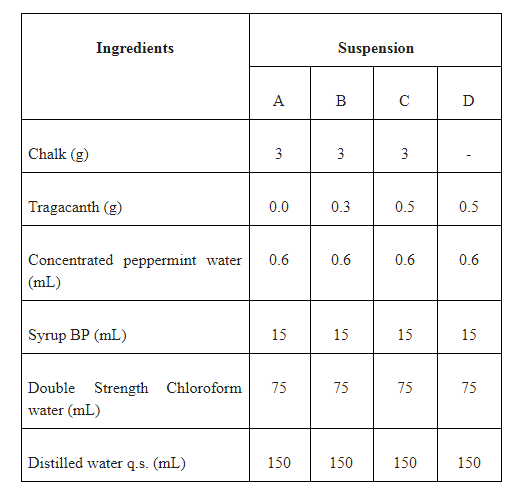
1. A suspension of Pediatric Chalk Mixture (150 mL) was prepared according to the following formula:
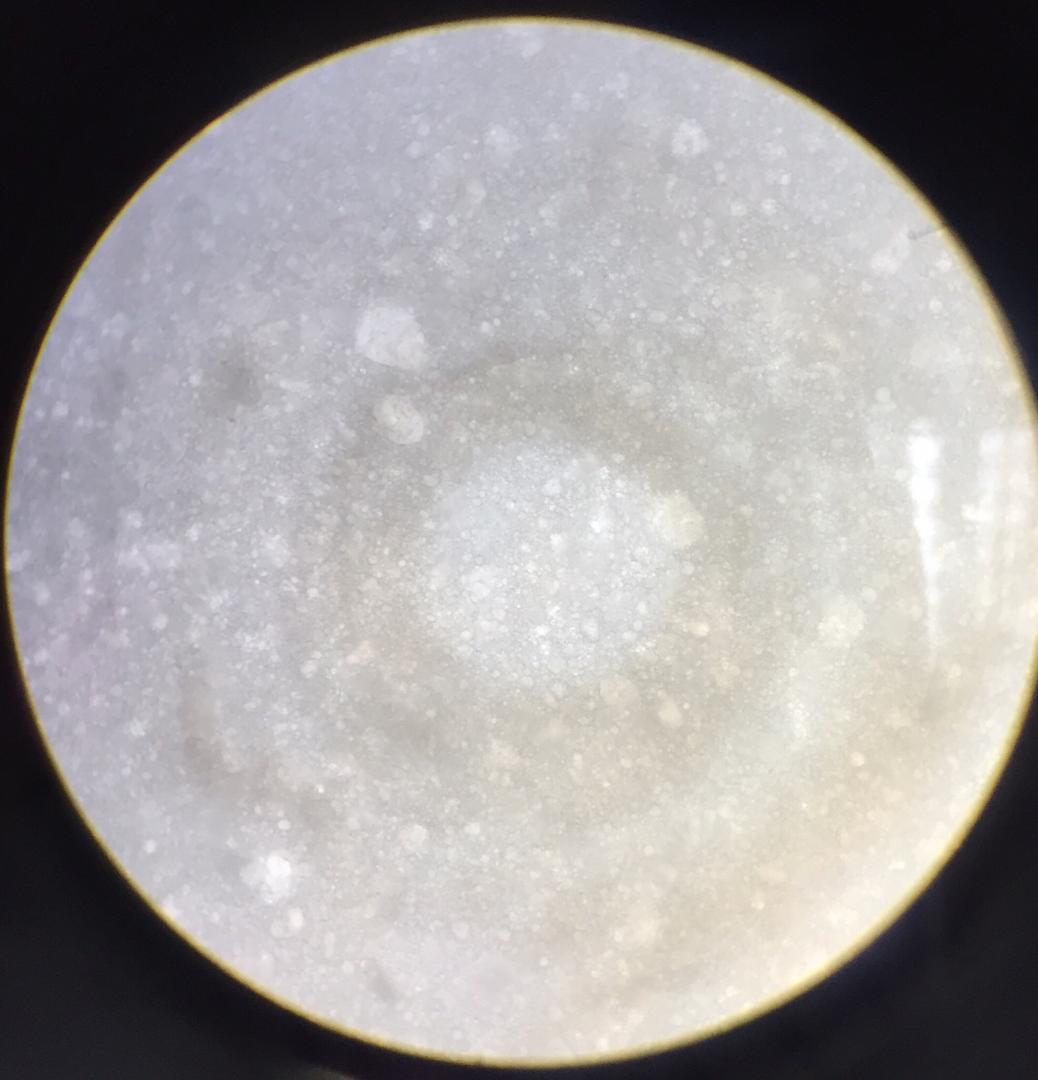
2. 5 mL of the suspension was poured into a weighing boat and each formulation was labelled. The texture, clarity and color of each suspension was observed and compared.
3. The sedimentation rate of each suspension was determined. The suspension was shaken vigorously so that all of the particles are uniformly suspended, and the time was taken. The boundary between the sediment and the supernatant was observed and the time it takes for the boundary to pass each 10 mL graduation until the volume of sediment has reached 80 mL was recorded.
**The best way to observe the boundary is to view it directly in front of a light source. You might try viewing it with sunlight from the windows as your light source. You should note whether there is a clear and distinct boundary or no obvious boundary.
4. The graduated cylinder was set down on the lab bench, and the lab timer started at this point.
5. For suspensions A to D, the sedimentation volume of the suspensions at t=0, 2, 5, 10, 15, and 30 min were recorded.
6. The sedimentation volume ratio was calculated using the following formula:
Sedimentation volume ratio = Hu/Ho
Hu: ultimate height of the sediment, i.e., the height of the sediment at a particular time
Ho: initial height of the total suspension
8. The ease of re-dispersibility of each formulation were examined by:
i) The Parafilm® was snugged on the mouth of the graduated cylinder, and the seal was re-enforce the with gloved hand.
ii) The number of inversions it takes to completely re-disperse the drug was recorded.
iii) The observation was recorded.
9. 95 mL of suspension was poured into a 100 mL beaker and the viscosity of the suspension was determined using viscometer at 12 000 rpm for 2 min. The data was recorded.
11. Each suspension was poured into a plastic bottle. After storing all the suspensions for a period of 4 days, the ease of redispersion in each system and which system is most acceptable was determined.
Results
Table 1 – The comparison of texture, clarity and color of each suspension.
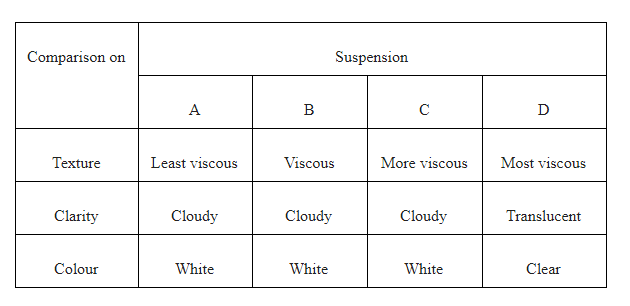
Table 2 – The boundary between sediment and supernatant and its time taken to pass each 10 ml graduation.
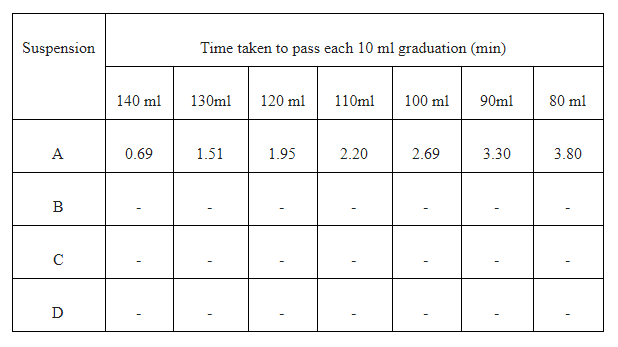
Table 3 – The sedimentation volume at pre-determined time.
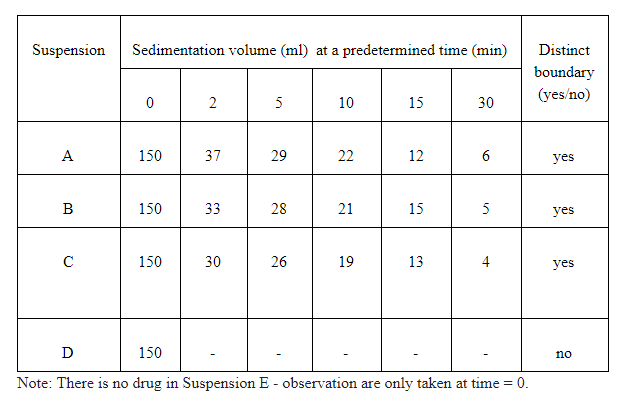
Table 4 – Calculation of sedimentation volume ratio.
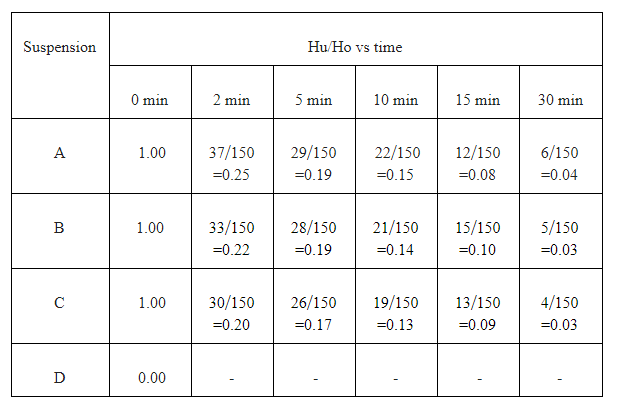
Sedimentation volume ratio = Hu/Ho
Hu : ultimate height of the sediment (the height of the sediment at a particular time)
Ho : initial height of the total suspension (150ml)
Table 5 – The ease of re-dispersibility of each formulation.
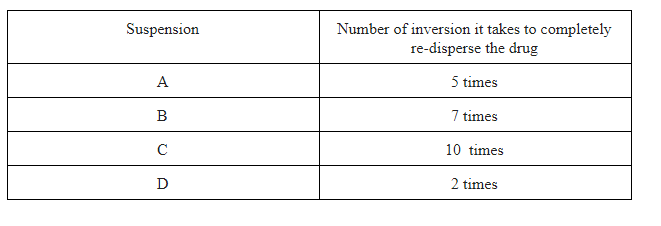
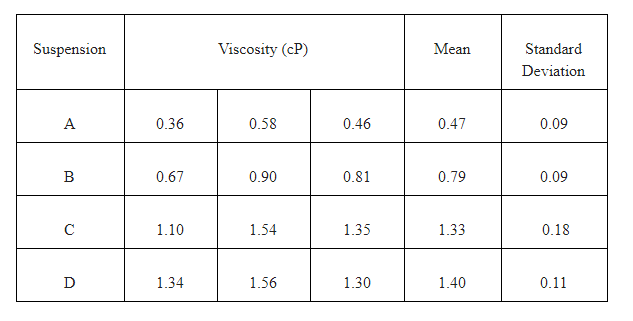
Table 6 – The viscosity, mean and standard deviation of each suspension.
Discussion
- Compare and discuss physical appearances of all the suspensions produced.
Suspension B is less viscous compared to suspension C but more viscous than suspension A. This is due to the presence of Tragacanth powder in Suspension B is less compared to in suspension C while in suspension A there is absence of Tragacanth powder. Tragacanth powder acts as a viscous factor when it poured into the suspension. Tragacanth is in the form of powder so it help more to produce viscous suspension.
Suspension A has the fastest rate of sedimentation compared to suspension B and C. This is due to the presence of wetting agents which is Tragacanth powder that slows the sedimentation of chalk in the suspension. This will help to lower the interfacial surface tension in the suspension and allows the contact of solid particles and liquid vehicles. Suspension C has the slowest rate of sedimentation where it takes longer time to sediment compared to suspension A and B. Suspension B is difficult to sediment compared to suspension A. Tragacanth powder in suspension B and C will slow sedimentation. Suspension D did not sediment because there is no presence of Tragacanth powder.
The colour of the suspension A B and C are white and cloudy due to the presence of chalk powder. However, suspension D have clear solution due to the absence of chalk powder.
- Plot Hu/Ho vs. time for each of the suspensions (Table 1) and discuss the findings.


Those three suspensions give the same exponential trendline. This means all of the suspensions have the same sedimentation rate. High concentration of tragacanth is supposed to have less sedimentation rate. In this experiment, the graph tells us that the differences between weight of tragacanth uses is not significant to give an effect on sedimentation rate. This is because the solid particles in this experiment have a very high density and also gravitational force to against the adhesive and adherence force caused by suspending agent. Therefore in further, tragacanth need to triturate firmly to reduce the particle size therefore they easily dispersed in the suspension. There is no graph for suspension D as there is no solid matter in that preparation.
- Briefly explain the principle of analysis using viscometer. Plot the viscosity vs. Tragacanth content (Table 2) and discuss the findings.
Viscometer is an instrument that measures the viscosity of fluid. Firstly, we need to know what is viscosity measured for. The substance’s resistance to motion under an applied force is what the viscosity measurement tell us (CSC Scientific Company, n.d). Therefore, viscometer work by getting the measurement of the resistance force that act upon the spinning spindle of the viscometer. Hence, high viscosity measurement means the spindle having a low torque (frequency become slower) or having a higher resistance. Unit of viscosity is milipascal second which mean a milipascal of force is act to move one layer of fluid in one layer to another in a second.

Based on the graph, we can say that viscosity of fluid is perpendicular to tragacanth content. The higher the tragacanth, the higher the viscosity of the fluid. Suspension without tragacanth or other suspending agent and only have syrup as a viscous media will only have viscosity around 0.8 cP and even lower without syrup.
- After storing the suspensions for a period of 4 days, determine the ease of redispersion of each.
| Suspension | The ease of redispersion of each |
| A | Quite Easy |
| B | Quite Hard |
| C | The most Hardest |
| D | The most easiest |
- Based on all of the observations, which product would be considered to be most acceptable? Explain.
Based on the results obtained, Suspension B would be considered to be the most acceptable. This is because suspension B has 0.3 g of tragacanth, which allow the chalk to be dispersed evenly for a period of time that is sufficient for pouring. This is very important to allow the correct dosage to be administered. Next, suspension B also has ideal viscosity which only need 6 times of inversion to allow the suspension to fully redispersed. Again, this is important to allow the administration of the correct active pharmaceutical ingredient to achieve the optimum therapeutic effect.
- Briefly explain the function of each excipient used in the suspension formulation. Explain the influence of tragacanth on the physical characteristics and stability of suspension.
| Ingredients | Function |
| Tragacanth | Suspending agent to suspend the chalk in the suspension |
| Concentrated peppermint water and syrup BP | For flavouring agent to increase the patience acceptance |
| Double strength chloroform water | For preservatives to prevent microbial growth |
Tragacanth are used as a wetting agent and by making it more viscous, they affect the physical characteristics of the suspension. Tragacanth act as wetting agents in which film around particles is formed and surface tension is reduced. Thus, in the liquid media, the insoluble chalk was suspended. The more tragacanth content, the more uniform the chalk in the liquid is dispersed, making it more viscous. High viscosity will reduce the rate of sedimentation and increase the stability of the suspension in longer period of time.
Conclusion
In conclusion, tragacanth is used as a wetting agent to reduce the surface tension of a liquid to allow it to be spread easily. Tragacanth influence the rate of sedimentation and the viscosity of the suspension. The ideal amount of tragacanth should be used as the suspension to allow correct dosage to be administered and to allow redispersion of the active ingredient after storage.
References
- CSC Scientific Company, Inc. (n.d.). Viscosity testing : testing the flow properties of liquid products. Retrieved from https://www.cscscientific.com/viscosity
- Vinensia (2013). Formulation. Retrieved from http://formulation.vinensia.com/2011/12/wetting-agents-for-suspensions.html?m=1
- Colony Gums Hydrocolloid & Stabilizer Systems : Tragacanth. Retrieved from https://colonygums.com/tragacanth/





 LAB REPORT DPP1 GROUP 10